More pics from this season











More pics from this season

No recipes today, only a few pics from my balcony…





This is a chocolate version of Biscotti, or Cantucci cookies. Usually made with plain flour and almonds, I made these wholemeal cookies adding chocolate, hazelnuts and spelt flour to the traditional recipe. I also tried using less sugar, but they didn’t taste as good. These cookies go well with coffee and tea, and kept a tin box they last for a long time.

Chocolate spelt biscotti with hazelnuts and almonds.
Ingredients
for 2 large trays of biscotti
150 g (5.29 oz) plain flour (unbleached all-purpuse flour)
150 g (5.29 oz) whole spelt flour
70 g (2.46 oz) hazelnuts, whole and some crushed
70 g (2.46 oz) almonds, whole and some crushed
3 eggs
170 g (5.99 oz) sugar
2 drops sweet orange essential oil (or some grated orange zest)
3 tablespoons unsweetened cocoa powder
80 g (2.82 oz) dark chocolate (70% cocoa solids) finely chopped
1/2 tablespoon acacia honey
4 g baking soda
marsala wine to taste (or milk )
a pinch of salt
Method.

1. Sift the flour with the baking soda and cocoa powder.
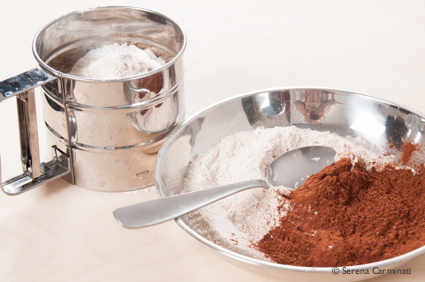
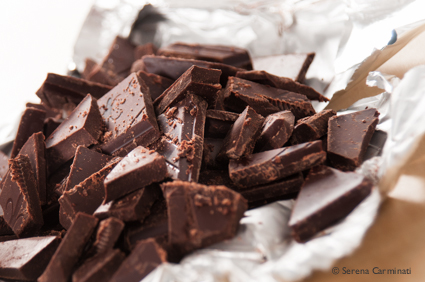
2. Add the chocolate, the hazelnuts, the almonds and a pinch of salt to the flour. Stir well.

3. Separately, mix two eggs, with the honey, the orange essential oil and sugar.

4. Combine all the ingredients together and mix well, adding some marsala wine (or milk) if the mixture is too dry.
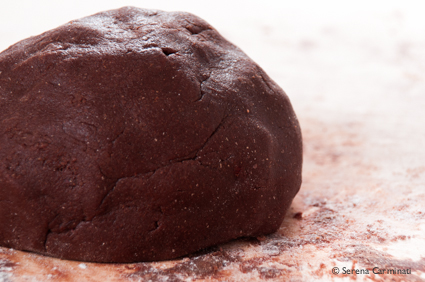
5. Divide the dough into four equal pieces, roll into the shape of four ropes and then brush the dough with an egg.

6. Bake at 190 ° C (374 °F) for 15-20 minutes. Remove from the oven and cut the cookies at a 45° angle, then bake for 5-10 minutes more at 190 ° C (374 °F).

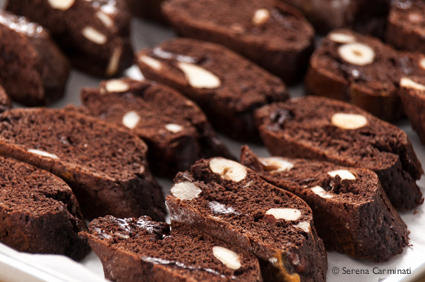
7. Let the cookies completely cool and store in a sealed tin box.

Cantucci di farina di farro al cioccolato.
Ingredienti
per 2 teglie di biscotti
150 g di farina 00
150 g di farina integrale di farro
70 g di nocciole, intere e sbriciolate
70 g di mandorle, intere e sbriciolate
3 uova
170 g di zucchero
2 gocce di olio essenziale di arancio dolce (oppure un po’ di buccia d’arancia)
3 cucchiai di cacao amaro
80 g di cioccolato fondente al 70% tagliato a pezzetti
1/2 cucchiaio di miele d’acacia
4 g di bicarbonato
marsala q. b. (o latte, a scelta)
un pizzico di sale
Preparazione.
1. Setacciate la farina con il bicarbonato e il cacao.
2. Aggiungete alla farina il cioccolato, le nocciole, le mandorle e un pizzico di sale. Mescolate con cura.
3. A parte, amalgamate due uova con il miele, l’olio essenziale d’arancia e lo zucchero.
4. Unite tutti gli ingredienti, aggiungendo un po’ di marsala (o latte) nel caso il composto fosse troppo asciutto.
5. Formate quattro filoni della stessa misura e spennellate la superficie con un uovo. Infornate a 190° C per 15-20 minuti.
6. Sfornate e tagliate i biscotti in obliquo (per dare la forma dei cantucci), quindi infornate nuovamente per 5-10 minuti (sempre a 190° C).
7. Lasciate raffreddare e conservate in un contenitore di latta ben chiuso.

Understanding flour strength.
In Italy, flour strength is indicated by a number followed by W. The W number is usually not indicated on the packaging of the product you buy at the supermarket. it’s possible to understand the strength of a flour by looking at the protein content indicated on the packaging.

Below you will find some reference data that might help you to understand the relationship between protein, flour strengths  and their uses.
|
|
|
|
|
|
|
|
|
|
|
|
|
|
|
|
|
|
|
|
|
|
|
|
|
|
|
The data shown here was taken from the teaching material of the Cereal Technology Course at Parma University (Italy), courtesy of Prof. Franco Antoniazzi.
Guida alle farine.
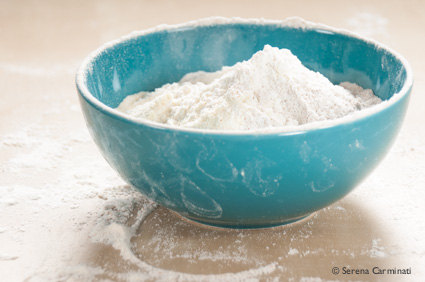
Capire la forza delle farine.
In Italia, la forza della farina si indica con un numero seguito da W. Nella confezione al supermercato non troverete questi parametri riportati sulla confezione. E’ possibile però farsi un’idea sulla forza di panificazione della farina leggendo le percentuali di proteine riportate sulla confezione del prodotto.
In questa tabella troverete alcuni dati di riferimento per capire meglio il rapporto tra le proteine,la forza di panificazione delle farine e i loro utilizzi.
|
|
|
|
|
|
|
|
|
|
|
|
|
|
|
|
|
|
|
|
|
|
|
|
|
|
|
I dati riportati nella tabella sono stati presi dal materiale didattico del corso di Tecnologia dei Cereali dell’Univeristà di Parma, per gentile concessione del Prof. Franco Antoniazzi.
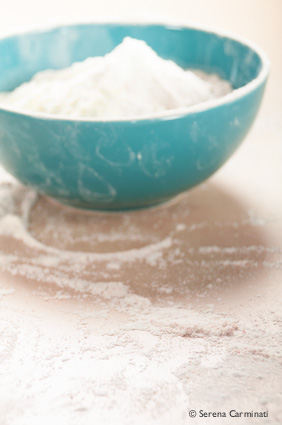

I made this recipe for a celiac friend. I used gluten-free flours, trying to create a smooth and homogeneous dough. The result is excellent! These soft and delicate cookies melt nicely in the mouth, slowly releasing an intense dark chocolate flavour.
If you prepare this recipe for a gluten-intolerant friend , use only flour, potato starch and corn starch specific for celiac people, and make sure that the absence of gluten is clearly indicated on the packaging.

Apple and chocolate chip cookies (gluten-free).
Ingredients
for about 25 cookies
70 g ( 2.4 oz) corn flour
70 g (2.4 oz) rice flour
70 g (2.4 oz) corn starch
70 g (2.4 oz) potato starch
150 g (5.29 oz) butter
130 g (4.5 oz) brown sugar
150 g (5.29 oz) dark chocolate for cooking
1 teaspoon baking soda
1 whole egg
1 large golden sweet apple
2 tablespoons yogurt
2 drops vanilla essence
a pinch of salt
Method.
1. In a bowl, sift the flour with the corn and potato starch.

2. Separately, mix the butter with sugar.

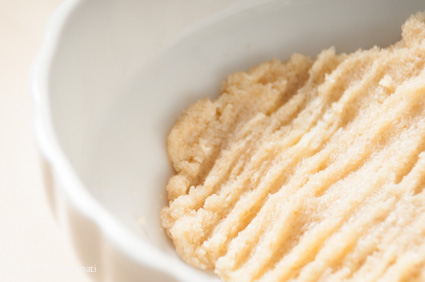
3. Add an egg with two drops of vanilla essence to the butter. Mix well, then add two tablespoons of yogurt and a teaspoon of baking soda to the mixture. Knead the dough.

4. Peel and cut the apple into very small cubes, break the chocolate into pieces and add them with a pinch of salt to the mixture.

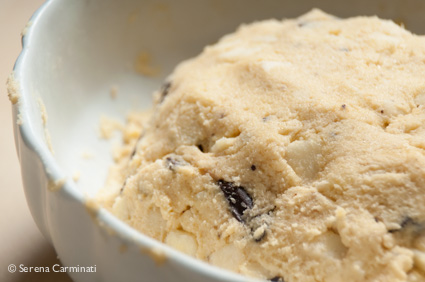
5. Put the dough to cool in the refrigerator for 30 minutes. Grease two or three baking sheets (depending on the size), shape the dough into small balls (4.5 cm each) and place them on the baking sheets, quite far apart from one another.

6. Slightly flatten the dough balls to make the cookies.
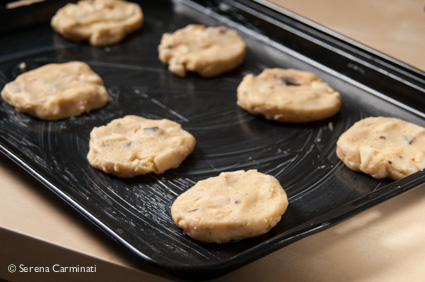
7. Bake at 170 ° C (338°F) for 15-18 minutes. Place the cookies to cool on a rack.
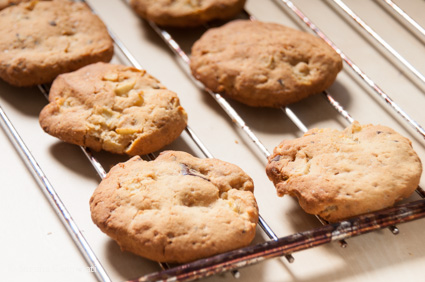
Biscotti morbidi con cioccolato e mele (senza glutine).
Ingredienti
per 25 biscotti circa
70 g di farina di mais
70 g di farina di riso
70 g di amido di mais
70 g di fecola di patate
150 g di burro
130 g zucchero di canna
150 g di cioccolato fondente per cucinare
1 cucchiaino di bicarbonato
1 uovo intero
1 mela grossa golden
2 cucchiai di yogurt
2 gocce di essenza di vaniglia
un pizzico di sale
Preparazione.
1. In una terrina, setacciate le farine con l’amido di mais e la fecola di patate. A parte, lavorate il burro con lo zucchero.
2. Aggiungete l’uovo con le gocce di essenza di vaniglia al burro lavorato.
3. Amalgamate bene e unite alla farina, aggiungendo due cucchiai di yogurt e un cucchiaino di bicarbonato. Impastate tutto.
4. Sbucciate e tagliate la mela a cubetti molto piccoli, rompete il cioccolato in pezzi ed aggiungeteli, con un pizzico di sale, all’impasto.
5. Mettete l’impasto a riposare per 30 minuti nel frigorifero. Imburrate due o tre teglie (dipende dalla grandezza), formate delle palline di circa 4,5 cm e mettetele sulle teglie, abbastanza distanti l’una dall’altra.
6. Schiacciate l’impasto per dare la forma ai biscotti.
7. Infornate a 170 ° per 15-18 minuti, poi lasciate raffreddare i biscotti su una griglia.
 Foodfulife